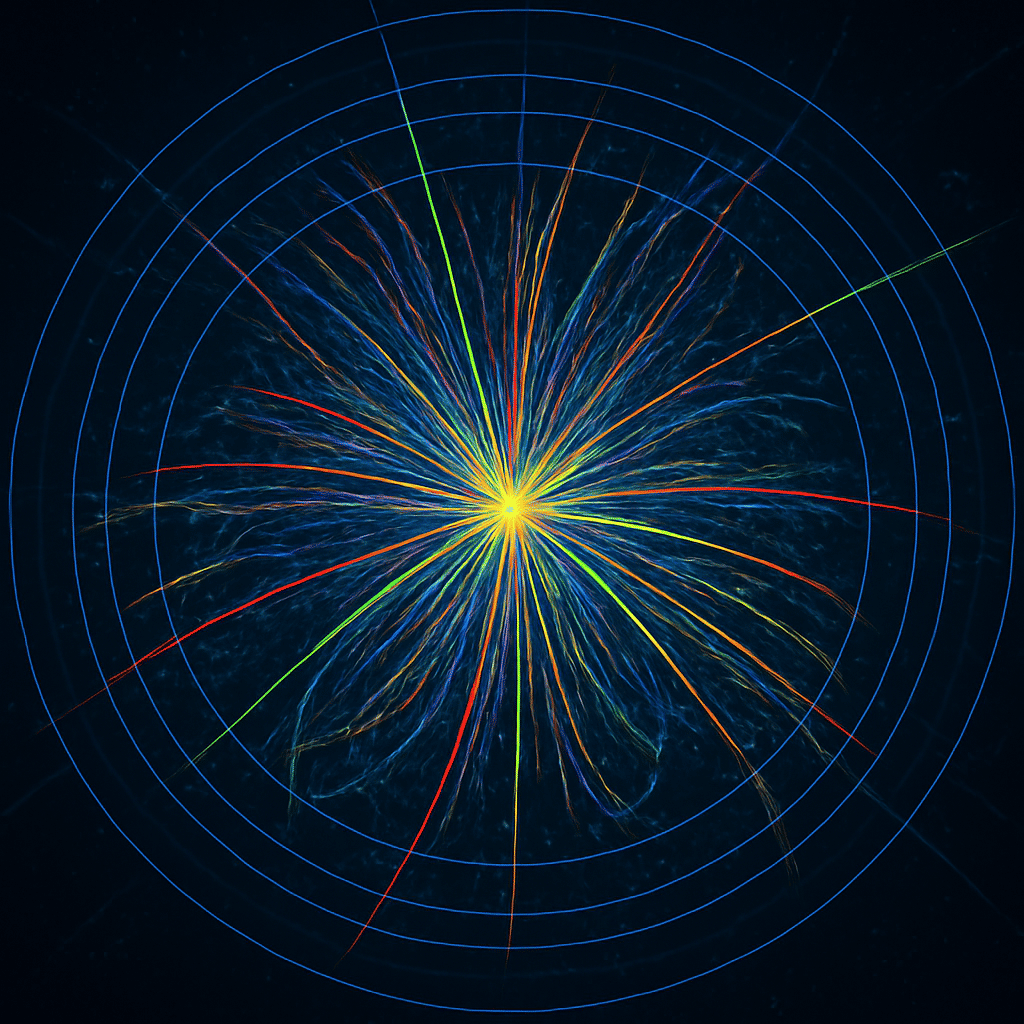
The world of particle physics is perpetually poised on the cusp of discovery, driven by the quest to understand the universe at its most fundamental level. Within this continuously evolving field, recent advancements are not only reshaping our comprehension of the building blocks of matter but are also challenging long-standing paradigms and prompting new questions about the fabric of reality itself.
At the heart of these advancements is the Large Hadron Collider (LHC) at CERN, an unparalleled instrument that has been instrumental in achieving groundbreaking discoveries. Since the monumental detection of the Higgs boson in 2012, physicists have been delving deeper into its properties. By examining how the Higgs field interacts with other particles, researchers aim to uncover more about the generation of mass and to test the limits of the Standard Model. Recent experiments have offered tantalizing hints of processes and particles beyond the expectations of this well-established framework, suggesting there may be a richer tapestry beneath.
One of the most exciting areas of investigation is the exploration of dark matter, which remains one of the universe's most enduring mysteries. While it exerts a significant gravitational influence on matter we can observe, direct detection has remained elusive. Current experiments at facilities like LHC are shifting focus toward seeking out hypothetical particles like WIMPs (Weakly Interacting Massive Particles) or axions, believed to contribute to the makeup of dark matter. By enhancing detector sensitivities and employing innovative techniques, researchers hope to achieve a breakthrough in identifying these enigmatic particles.
In addition to dark matter, the study of neutrinos has been gaining momentum. These elusive particles barely interact with matter, making them difficult to study, yet offering a wealth of information about the universe. Recent collaborations, such as those involving the T2K experiment in Japan and IceCube observatory in Antarctica, have observed rare neutrino oscillations and behaviors that could unlock new physics. The information gleaned from these phenomena may provide insights into why the universe is composed predominantly of matter rather than antimatter.
Another frontier in particle physics involves exploring the potential existence of additional dimensions. Theoretical frameworks like string theory suggest that our universe might be but one facet of a multilayered, multidimensional reality. Efforts to find physical proof of extra dimensions have included scrutinizing gravitational waves and searching for anomalies in particle collision outcomes. While direct evidence remains elusive, each experiment brings us steps closer to confirming or refuting these compelling hypotheses.
Quantum computing is also making remarkable strides in supporting particle physics research. The ability to simulate complex quantum systems and interactions could enable researchers to solve longstanding puzzles and test new theories at unprecedented speeds. As quantum algorithms and technologies evolve, they are likely to play a pivotal role in breaking theoretical ground that has so far been constrained by computational limitations.
The advancement of particle physics is a testament to international cooperation and the inexorable human desire to uncover the unknown. As we continue to push the boundaries of what is possible, each discovery acts as a beacon, illuminating the pathways to deeper understanding while raising new questions about the universe's most fundamental aspects. The quest continues, driven by curiosity and the promise of uncovering the profound truths of our reality.